





Step-by-Step Shotcreting Process
[edit] Step-by-Step Shotcreting Process: Complete Guide to Shotcrete Application
The shotcreting process also known as the shotcrete process is a high-performance method of applying concrete or mortar at high velocity onto surfaces. It is widely used in structural repair, slope stabilization, tunneling, and strengthening works.
If you’re searching “how shotcreting is done” or “shotcrete application steps”, this guide explains the complete step-by-step process with technical insights, helping engineers, contractors, and project owners make informed decisions.
[edit] What Is Shotcreting?
Shotcreting is a method where cementitious material is pneumatically projected onto a surface using compressed air. The high velocity ensures:
- Dense compaction
- Strong bond with substrate
- Reduced permeability
Two main methods:
- Dry Mix Shotcrete (Gunite)
- Wet Mix Shotcrete
[edit] Step-by-Step Shotcreting Process
1. Surface Preparation (Critical for Bond Strength)
Before shotcreting begins, the surface must be properly prepared.
Key Activities:
- Remove loose concrete, dust, oil, and contaminants
- Use mechanical chipping or hydro-demolition
- Clean with air or water jetting
Technical Note: A roughened surface improves mechanical interlocking, increasing bond strength.
[edit] 2. Installation of Reinforcement (If Required)
For structural applications, reinforcement is added.
Includes:
Why It Matters: Reinforcement improves:
[edit] 3. Formwork or Guide Setup (Optional)
In some cases, guides or minimal formwork are used to control thickness.
Used In:
- Vertical repairs
- Overhead applications
- Thick structural layers
[edit] 4. Mixing of Shotcrete Material
The mix design depends on application and method.
- Cement
- Fine & coarse aggregates
- Water
- Admixtures (accelerators, plasticizers)
Technical Terms:
- Water-Cement Ratio (w/c ratio): Controls strength and durability
- Admixtures: Improve workability and setting time
[edit] 5. Shotcreting Application (Core Process)
Concrete is sprayed using a nozzle at high velocity.
Process:
- Material is conveyed through a hose
- Air pressure propels it onto the surface
- Nozzleman controls angle and distance
- Maintain proper nozzle angle (90° ideal)
- Keep consistent distance (1-1.5 meters)
- Apply in layers (passes)
Technical Term:
[edit] 6. Layering and Thickness Control
Shotcrete is applied in multiple layers depending on design.
Typical Thickness:
- Repair work: 25-50 mm
- Structural strengthening: 50-100 mm or more
Key Point: Each layer must set properly before the next application.
[edit] 7. Finishing and Surface Treatment
After application, the surface is finished based on requirements.
Methods:
[edit] 8. Curing (Essential for Strength Development)
Proper curing ensures durability and strength.
Methods:
Duration: Minimum 7 days recommended
[edit] 9. Quality Control and Testing
To ensure performance, testing is done.
Tests Include:
Standards:
Follow guidelines like:
[edit] 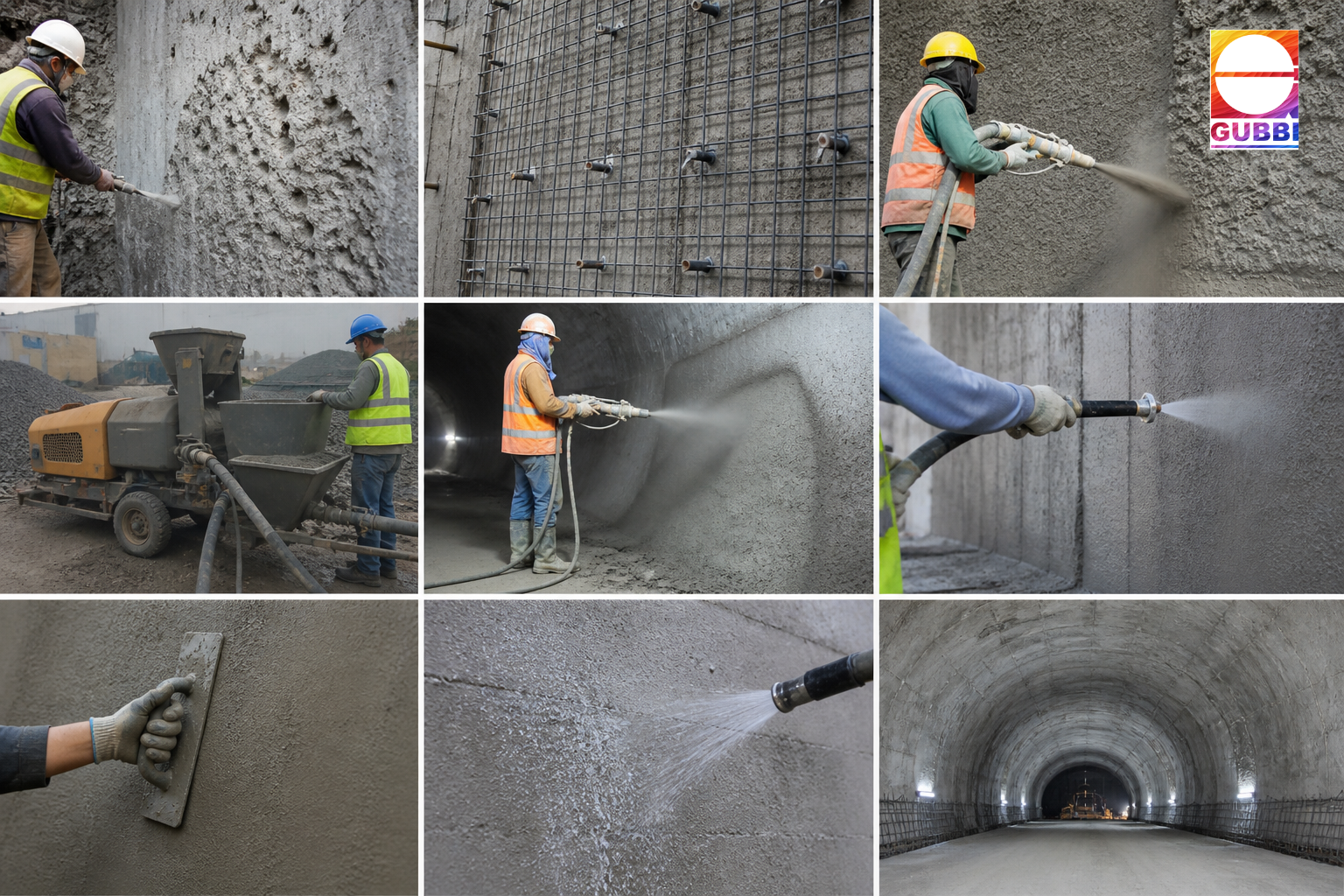
[edit] Dry Mix vs Wet Mix Shotcreting Process
| Feature | Dry Mix | Wet Mix |
| Water Addition | At nozzle | Pre-mixed |
| Control | Operator dependent | Better consistency |
| Dust | High | Low |
| Use Case | Small repairs | Large-scale projects |
[edit] Applications of Shotcreting
The shotcreting process is widely used in:
- Structural repair and rehabilitation
- Tunnel lining and mining
- Slope stabilization
- Swimming pool construction
- Retrofitting of RCC structures
[edit] Advantages of Shotcreting
- High bond strength
- Fast application
- Reduced formwork
- Dense and durable concrete
- Ideal for complex shapes
[edit] Common Problems in Shotcreting
[edit] Pro Tips for Better Shotcreting Results
- Always ensure proper surface preparation
- Use experienced nozzle operators
- Maintain correct air pressure and angle
- Avoid rebound reuse
- Follow strict curing practices
[edit] Conclusion
The shotcreting process is a powerful and efficient solution for modern construction and structural repair. When executed with proper technique, materials, and quality control, it delivers long-lasting strength, durability, and performance.
[edit] FAQs
[edit] 1. What is the process of shotcreting?
It involves surface preparation, reinforcement fixing, material mixing, high-velocity spraying, finishing, curing, and quality testing.
[edit] 2. What is the difference between shotcrete and concrete?
Shotcrete is sprayed using air pressure, while conventional concrete is poured.
[edit] 3. Is shotcrete stronger than normal concrete?
Yes, due to better compaction and bonding when applied correctly.
[edit] 4. Where is shotcreting used?
In tunnels, repairs, slopes, swimming pools, and structural strengthening.
Featured articles
Check out some of the best features and news from Designing Buildings as well as key stories from around the web.

Government launches a one stop shop for flood preparedness.

Sir Edwin Lutyens: Britain's greatest architect? Book review.

CIOB publishes free template to help assess and manage risks.
ECA's reflections on Party Conference season

Burnham wants to be confident of winning before asking for a fresh mandate.
New Chief Construction and Scientific Adviser

Sergio Cavalaro, Professor of Infrastructure Systems at Loughborough University.
Building safety levy for England

CIAT publish estimator tool for members.

Water sector faces a growing crisis that could slow the delivery of vital infrastructure.
Undervaluing our industrial past

Heritage value changes as taste for building styles changes.
Changing expectations around competence and compliance

New information sheet from CIAT.
Grenfell investigation files passed to CPS

Angela Rayner apologises on behalf of the British state.

Electrical contractors need to understand the practical implications.

The real barrier to getting more value from digital technology.